


Nepal Floods: Disaster Management and India – Nepal Cooperation
Context
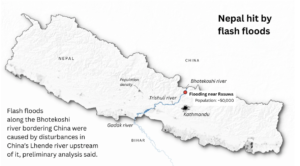
Severe flash floods in Nepal’s Rasuwa district caused extensive destruction, with hundreds of people reported dead or missing. A large number of Indians were also among those affected. Satellite imagery indicated a possible blockage or lake formation upstream of the Bhotekoshi River, raising concerns about a sudden release of water.
Key Highlights
- More than 800 people were rescued, while hundreds remained missing, including foreign nationals.
- Satellite images suggested a possible lake or blockage upstream of the Bhotekoshi River.
- Nepal deployed its Army, Police and Armed Police Force for extensive search-and-rescue operations.
- India initiated efforts to trace missing Indian nationals and provided humanitarian assistance and relief materials.
- The disaster highlights the Himalayan region’s vulnerability to flash floods, landslides and glacial hazards.
- Such disasters underline the need for stronger India – Nepal cooperation and coordinated disaster management.
Key Concepts
Flash Flood:
A sudden and rapidly developing flood caused by intense rainfall, cloudbursts, rapid surface runoff or the sudden release of water.
Glacial Lake Outburst Flood (GLOF):
A flood that occurs when water stored in a glacial lake is suddenly released due to the breach or failure of its natural or ice barrier.
Himalayan Cryosphere:
The frozen-water component of the Himalayan region, including glaciers, snow cover, permafrost and glacial lakes. Changes in the cryosphere due to rising temperatures can affect water availability and increase disaster risks.
Disaster Diplomacy:
Cooperation between countries during and after disasters through rescue operations, humanitarian assistance, information sharing and relief efforts. Such cooperation can also strengthen diplomatic relations.
Early Warning Systems:
Systems that use meteorological, hydrological, satellite and communication technologies to detect hazards early, issue warnings and facilitate timely evacuation.
Way Forward
India and Nepal should strengthen real time hydrological data sharing, satellite based monitoring and transboundary early warning systems. Joint scientific mapping of glacial lakes, continuous monitoring of climate-induced changes in the Himalayas and coordinated disaster-response mechanisms can help reduce the loss of life and property.