


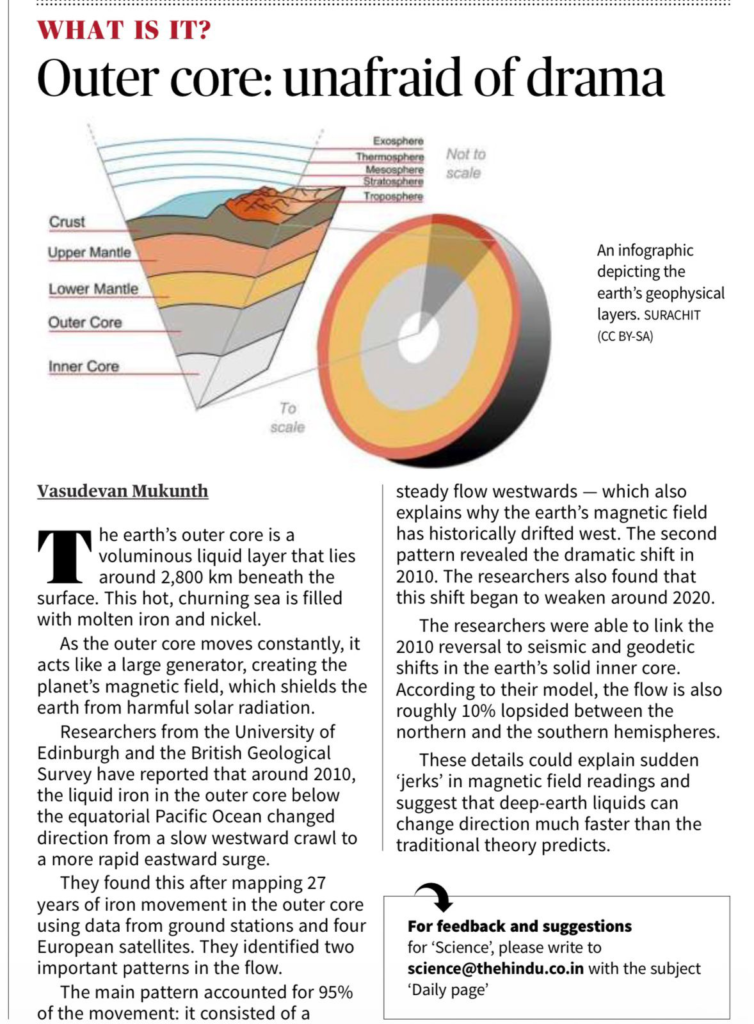
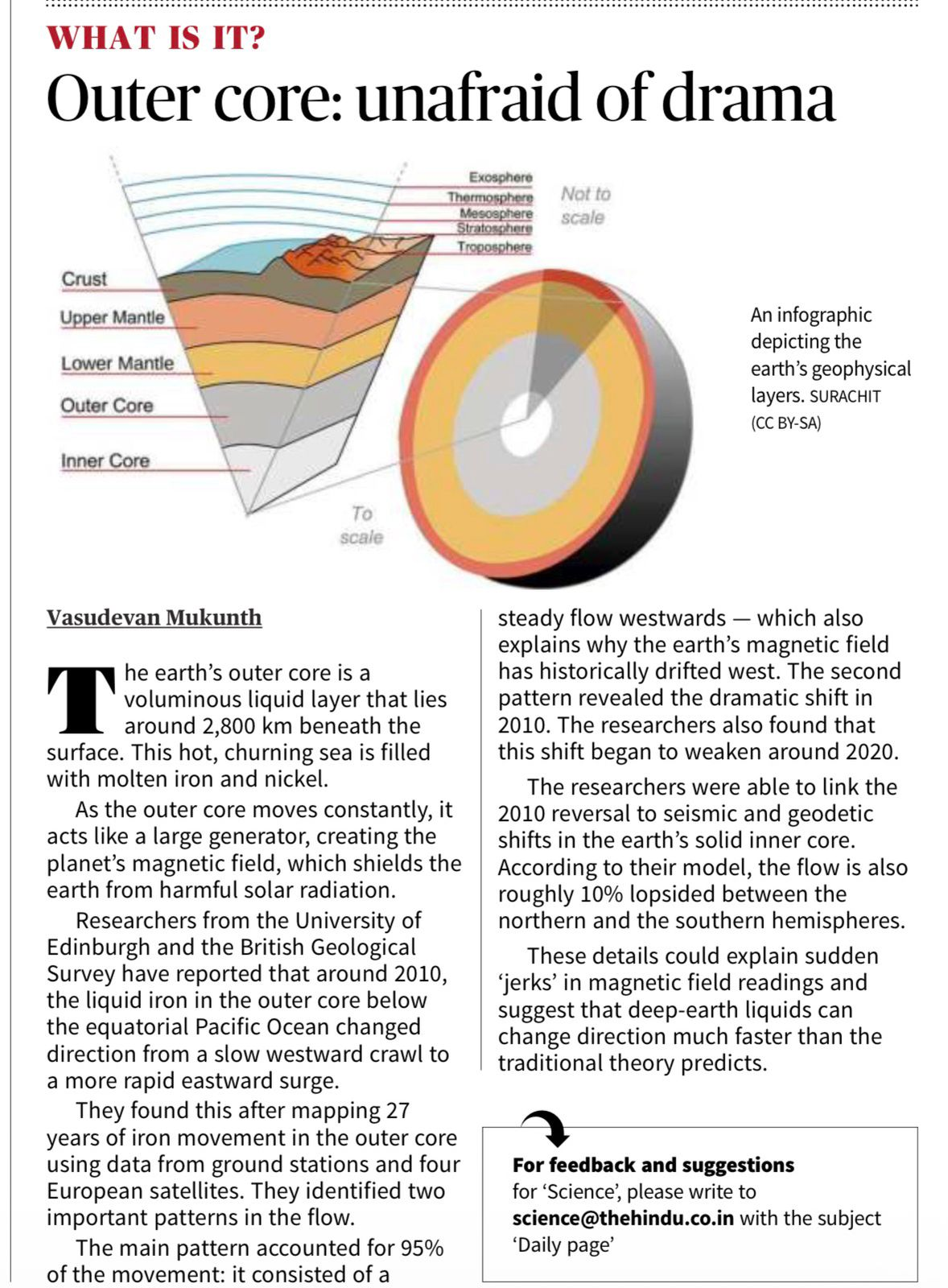
Outer Core: Unafraid of Drama
What Happened
Researchers analysing satellite and geomagnetic observations reported significant changes in the movement patterns of Earth’s liquid outer core around 2010, offering new insights into the processes that generate Earth’s magnetic field.
Key Highlights
- Scientists observed a shift in liquid iron flow beneath the equatorial region from slow westward movement to a rapid eastward surge around 2010.
- Researchers reconstructed outer-core circulation using nearly three decades of geomagnetic observations and satellite data.
- Findings suggest that changes deep within Earth’s interior can occur faster than previously assumed.
- Variations in outer-core flow may explain sudden disturbances or “jerks” in Earth’s magnetic field.
- The 2010 reversal was linked to seismic and geodetic shifts occurring within Earth’s inner core.
- Researchers also found asymmetry in flow patterns between the northern and southern hemispheres.
Key Facts
- The outer core lies around 2,900 km beneath Earth’s surface and consists mainly of molten iron and nickel surrounding the solid inner core.
- Movement within the liquid outer core generates Earth’s magnetic field through the geodynamo process.
- Earth’s magnetic field protects the planet from harmful solar and cosmic radiation.
- Scientists used 27 years of geomagnetic data from ground stations and European satellites to map fluid motion inside the outer core.
- The dominant westward flow pattern historically explained the westward drift of Earth’s magnetic field.
- Understanding outer-core dynamics is important for improving navigation systems, satellite operations and geomagnetic-field modelling.