


El Niño
Source : Wikipedia
Context: The India Meteorological Department (IMD) has officially announced the re-emergence of El Niño conditions in the equatorial Pacific Ocean.
Prelims :
El Niño, meaning “The Boy Child” in Spanish, represents the warm phase of the El Niño Southern Oscillation (ENSO), a large-scale climate pattern influenced by periodic warming of sea surface temperatures across the central and eastern tropical Pacific Ocean along with corresponding changes in atmospheric circulation. It is the opposite of La Niña, the cooler phase of the cycle, and is separated by neutral ENSO conditions.
Formation :
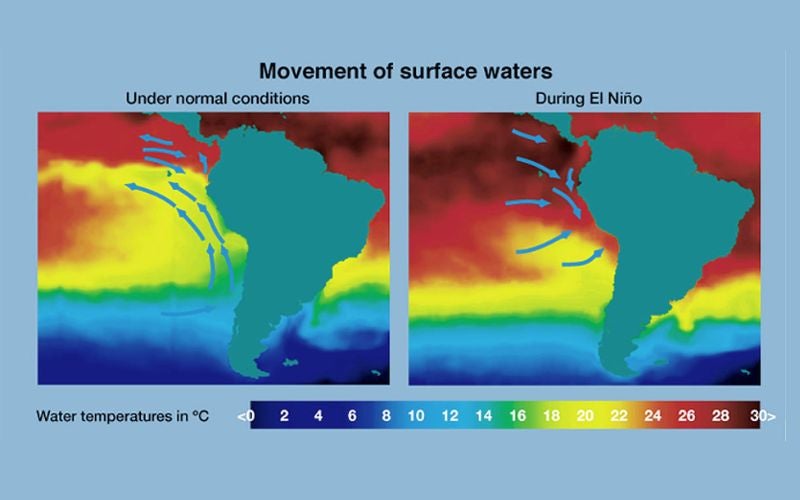
Under normal conditions, trade winds blow steadily from east to west along the equator, pushing warm surface waters toward the western Pacific and allowing colder, nutrient-rich waters to rise along the western coast of South America.
El Niño develops when this ocean-atmosphere system becomes disrupted:
- Weakening of Trade Winds: For reasons that are still not fully understood, the usual easterly trade winds weaken considerably or even reverse, beginning to blow from west to east.
- Movement of Warm Waters Eastward: As the winds lose strength, the large pool of warm water accumulated near Indonesia gradually shifts eastward across the Pacific Ocean toward the South American coastline.
- Deepening of the Thermocline: The eastward spread of warm water pushes down the thermocline, the boundary between warm surface water and colder deep water, reducing the upwelling of nutrient-rich cold water off the coasts of Peru and Ecuador.
- Atmospheric Response: Rising sea surface temperatures trigger changes in the atmosphere. Thunderstorm activity and rising air currents shift eastward into the central Pacific, influencing jet streams and altering weather patterns across different parts of the world.
Key Features of El Niño:
- Irregular Recurrence Pattern: El Niño events do not occur at fixed intervals and generally appear every two to seven years. Significant events since 2000 have occurred in 2002, 2009, 2015, and 2023.
- Temporary Increase in Global Temperatures: By releasing large amounts of stored ocean heat into the atmosphere, El Niño often contributes to unusually warm global temperatures and can help drive record-breaking heat years.
- Disruption of the Walker Circulation: The phenomenon weakens the normal Walker Circulation, a tropical atmospheric circulation system, leading to shifts in pressure patterns and rainfall distribution across the Pacific region.
- Impact on Marine Ecosystems and Fisheries: Reduced upwelling limits the supply of nutrients in surface waters, affecting marine food chains. This often results in sharp declines in fish populations, particularly anchoveta fisheries along the South American coast, causing economic losses for fishing communities.