


Cauvery Water Management Authority Upholds Water Release to Tamil Nadu
Context
The Cauvery Water Management Authority (CWMA) has endorsed the recommendation of the Cauvery Water Regulation Committee (CWRC), directing Karnataka to release 3,500 cusecs of water per day for 15 days to Tamil Nadu. The decision was taken despite Karnataka’s concerns over inadequate rainfall and declining reservoir levels.
Key Highlights
- After assessing the prevailing hydrological situation, the CWMA supported the CWRC’s recommendation and instructed Karnataka to continue releasing water to Tamil Nadu as per the established water-sharing arrangement.
- Karnataka requested a review of the release order, citing below normal rainfall and reduced storage in its reservoirs, and argued that the current conditions justified suspending water releases.
- The Authority maintained that water allocation should follow the prescribed sharing mechanism while considering factors such as rainfall, reservoir storage and basin inflows to ensure equitable distribution.
Key Concepts
- The Cauvery Water Management Authority (CWMA) was established in 2018 under the Inter-State River Water Disputes Act, 1956, to implement the Supreme Court’s verdict on the Cauvery water dispute.
- The Cauvery Water Regulation Committee (CWRC) oversees reservoir conditions, analyses hydrological data and advises the CWMA on periodic water releases among the basin States.
- Article 262 of the Constitution empowers Parliament to legislate on the adjudication of disputes relating to inter-State river waters and, where provided by law, bars judicial intervention.
- The Inter State River Water Disputes Act, 1956 provides the legal framework for resolving conflicts involving inter-State rivers.
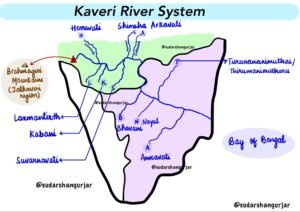
- The Cauvery River Basin is shared by Karnataka, Tamil Nadu, Kerala and the Union Territory of Puducherry, making coordinated basin management essential.
Way Forward
A sustainable solution requires strengthening integrated river basin management through real-time hydrological monitoring, improved water-use efficiency, scientific reservoir operations, and greater cooperation among the basin States in line with the principles of cooperative federalism.