


Cauvery Water Sharing: Supreme Court Questions Water Deficit During Drought
Context
Tamil Nadu sought the release of pending Cauvery water, citing a shortfall in water deliveries, while Karnataka referred to drought conditions, declining reservoir levels and the need to meet drinking-water requirements. The Supreme Court questioned the feasibility of releasing the outstanding water allocation amid severe water scarcity.
Key Highlights
- Agricultural impact: Tamil Nadu reported a deficit of 11.719 thousand million cubic feet (TMC ft), which affected Samba paddy cultivation.
- Differences in rainfall: Karnataka argued that it does not receive the replenishment from the northeast monsoon that benefits Tamil Nadu.
- Inter State tensions: Irregular monsoon patterns and water shortages intensify disagreements over the distribution of river water between states.
- Basin level assessment: Water allocation decisions need to consider rainfall, reservoir storage, agricultural demand and environmental requirements across the entire river basin.
Key Concepts
- Cauvery Basin
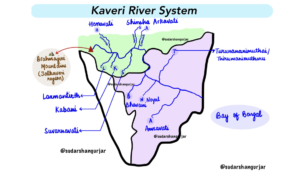
The Cauvery river system originates in the Western Ghats of Karnataka and flows through Tamil Nadu before draining into the Bay of Bengal.
- Cauvery Water Management Authority (CWMA)
The CWMA was established to oversee the implementation of Cauvery water-sharing arrangements following the Supreme Court’s 2018 decision.
- Article 262
Article 262 of the Indian Constitution empowers Parliament to provide for the adjudication of disputes concerning the waters of inter State rivers and river valleys. It also allows Parliament to exclude the jurisdiction of the Supreme Court and other courts over such disputes, as provided by law.
- Inter State River Water Disputes Act, 1956
This legislation provides a tribunal-based mechanism for adjudicating specified disputes concerning the sharing of water from inter-State rivers.
- TMC ft
TMC ft stands for thousand million cubic feet. It is a unit used to measure reservoir storage capacity and the volume of water allocated between states.
- Samba Crop
Samba is a long duration rice cultivation season in Tamil Nadu. Its productivity depends on the timely availability of irrigation water.
Way Forward
- Transparent water accounting: Introduce reliable telemetry systems and joint, real-time monitoring of reservoir storage and water releases.
- Drought sensitive allocation: Follow clearly defined, rule-based water-release arrangements that account for drought conditions while complying with applicable legal orders.
- Improve irrigation efficiency: Encourage efficient irrigation practices and suitable crop choices to reduce agricultural water demand.
- Strengthen watershed management: Promote water reuse and watershed restoration to improve water availability and reduce pressure on river systems.
- Cooperative federalism: Encourage dialogue and coordination between basin states to ensure equitable water distribution while addressing drinking-water, agricultural and environmental needs.