


- Ocean water is constantly in motion due to various physical characteristics and external forces.
- The motion of ocean water can be classified into two directions: horizontal and vertical.
- Horizontal movements of ocean water include waves and currents.
- Vertical movements of ocean water include tides and upwelling.
Ocean Waves
- Wave is a rhythmic movement that carries energy through matter or space.
- Ocean Waves are the undulatory motion of a water surface.
- Waves are oscillatory movements that cause the rise and fall of the water surface
- Waves are a type of horizontal movement of ocean water
- Waves are the movement of energy across the ocean surface, provided by the wind
- In a wave, each water particle moves in a circular manner
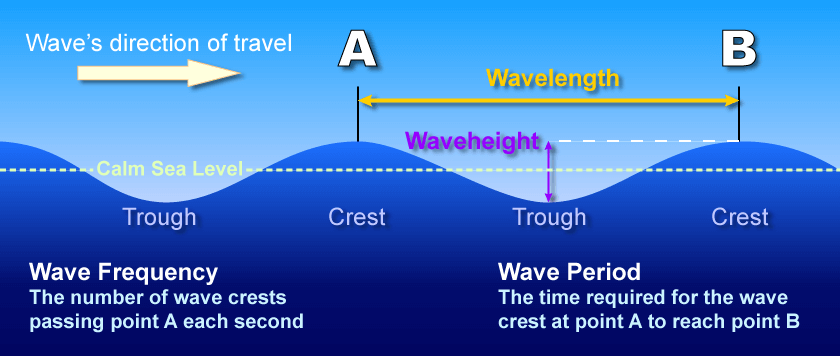
- A wave has two main parts: the raised part called the crest, and the low-point called the trough.
- Parts of a wave:
- Wave crest: highest point of a wave
- Wave trough: lowest point of a wave
- Wave height: It is the perpendicular distance from the bottom of a trough to the top of a crest of a wave.
- Wave amplitude: It is one-half of the wave height.
- Wave period: It is merely the time interval between two successive wave crests or troughs as they pass a fixed point.
- Wavelength: It is the horizontal distance between two successive crests.
- Wave speed: It is the rate at which the wave moves through the water (measured in knots)
- Frequency: the number of complete waves (or oscillations) that occur over a given period of time. Usually measured in cycles per second.
- Most of the waves present on the ocean’s surface are wind-generated waves.
- Friction from the wind moving over the water causes the water to move along with the wind. If the wind speed is high enough, the water begins to pile up and a wave is formed.
- As wind velocity increases: Wavelength, Wave period, Height Increase.
- Water molecules move in an orbital motion as the wave passes.
- Particles of water move around in circles. The farther below the surface, the smaller the circle.
- As the wave slows, its crest and trough come closer together. The top of the wave is not slowed by friction and moves faster than the bottom.

Wave cut Action
