


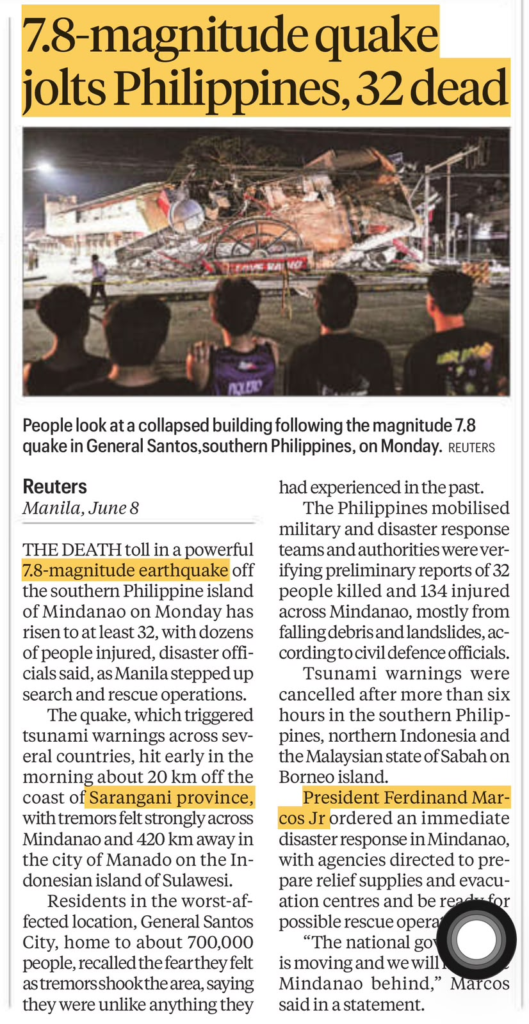
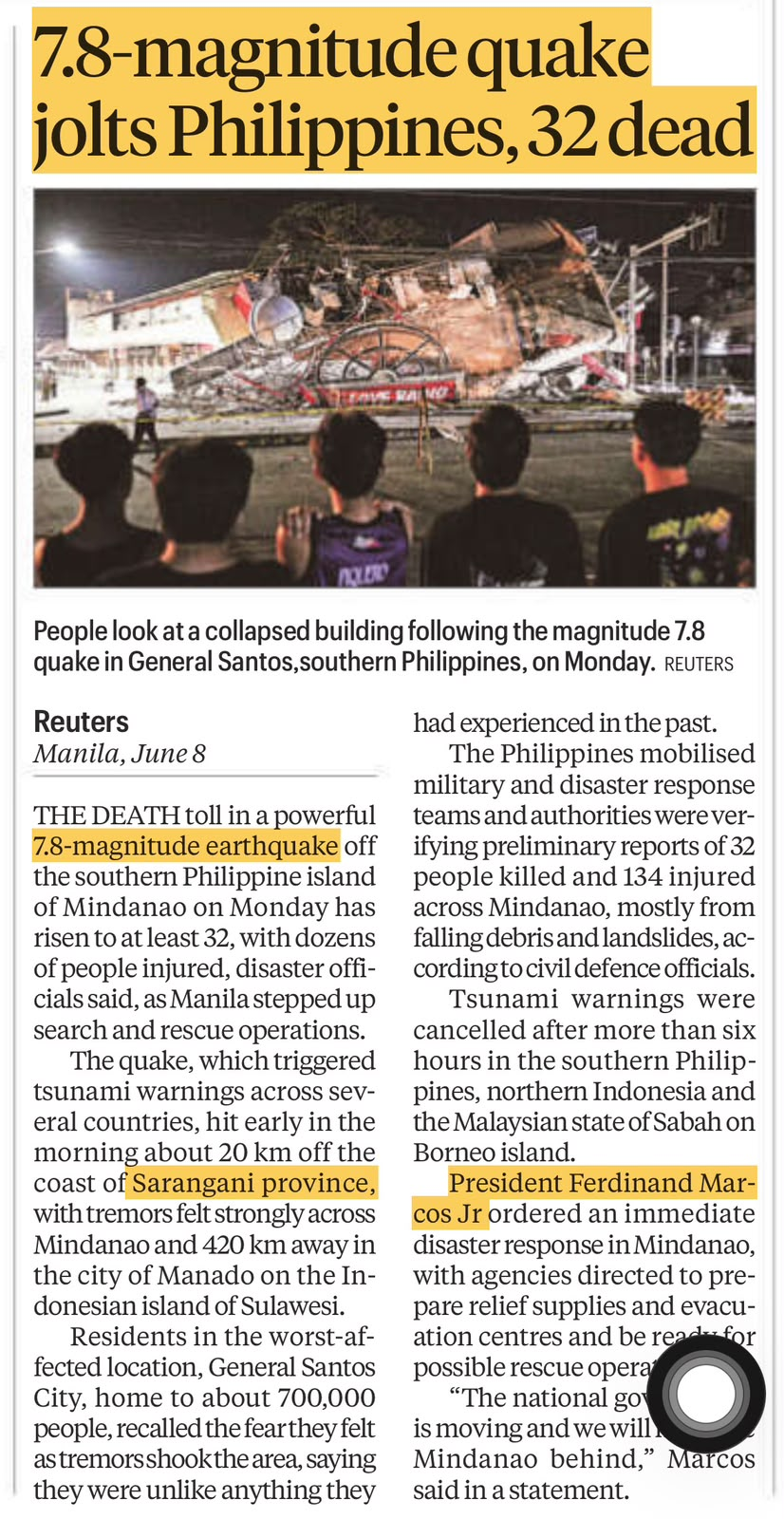
Earthquake in Philippines
Context : The article reports that a 7.8-magnitude earthquake off Mindanao caused significant casualties and damage, triggered tsunami warnings, and prompted large-scale disaster response efforts by the Philippine government.
Prelims-Oriented Pointers
- A 7.8-magnitude earthquake struck off the southern Philippine island of Mindanao.
- The death toll rose to at least 32, while 134 people were injured.
- The earthquake occurred about 20 km off the coast of Sarangani province.
- Tremors were felt strongly across Mindanao and as far as Manado on Indonesia’s Sulawesi Island.
- General Santos City, with a population of about 700,000, was among the worst-affected areas.
- The earthquake triggered tsunami warnings in several countries.
- Tsunami warnings were later cancelled in:
- Southern Philippines
- Northern Indonesia
- Sabah (Malaysia)
- Many casualties were caused by falling debris and landslides.
- The Philippines deployed military and disaster response teams for rescue operations.
- President Ferdinand Marcos Jr. ordered an immediate disaster response in Mindanao.
Mains-Relevant Information (Concise)
1. Disaster Impact
- The earthquake caused deaths, injuries and damage to infrastructure.
- Landslides and collapsing structures contributed to casualties.
2. Tsunami and Regional Effects
- The quake triggered tsunami alerts across neighbouring regions.
- The warnings were withdrawn after authorities assessed the threat.
3. Disaster Response
- The Philippine government mobilised rescue and relief teams.
- Authorities were directed to prepare evacuation centres and relief supplies.
4. Multi-Hazard Nature of Earthquakes
- The article highlights that earthquakes can trigger secondary hazards such as tsunamis and landslides.
- Effective disaster preparedness requires coordinated response mechanisms.