


Great Indian Bustard Chicks Shifted to Rewilding Tunnel
Context
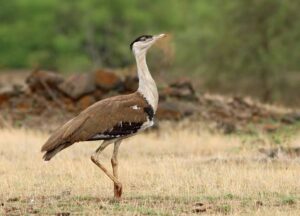
In a first for the conservation programme, three captive-bred Great Indian Bustard (GIB) chicks have been shifted to a specially designed rewilding tunnel at the Godawan Conservation Centre, Ramdevra (Jaisalmer, Rajasthan). The initiative is part of the species recovery programme aimed at preparing captive-bred birds for successful release into the wild.
Key Highlights
- A ₹9.25 crore rewilding facility has been established to simulate natural conditions while minimising human interaction, helping captive-bred birds adapt to life in the wild.
- The chicks will spend nearly four months inside the rewilding tunnel under CCTV surveillance, where food will be provided without direct human contact. They will later be released into the Desert National Park.
- The Great Indian Bustard (Godawan) is the State Bird of Rajasthan.
- The initiative marks a shift from captive breeding towards the more challenging objective of establishing a self-sustaining wild population.
Key Concepts
Great Indian Bustard (Ardeotis nigriceps)
- One of the heaviest flying birds in the world, inhabiting arid and semi-arid grasslands.
- Categorised as Critically Endangered on the IUCN Red List.
- Protected under Schedule I of the Wildlife (Protection) Act, 1972, and listed in Appendix I of CITES and the Convention on Migratory Species (CMS).
- Its global population is estimated at fewer than 150 individuals, most of which survive in Rajasthan’s Thar Desert.
Threats to the Great Indian Bustard
- Collision with overhead power transmission lines is the leading cause of adult mortality.
- Habitat degradation due to agricultural expansion and infrastructure development.
- Predation of ground nests by free-ranging dogs.
- Very low reproductive rate, with females generally laying only one egg each year.
Supreme Court Rulings
- In 2021, the Supreme Court directed the undergrounding of power lines in critical Great Indian Bustard habitats.
- In M.K. Ranjitsinh v. Union of India (2024), the Court modified its earlier directions by balancing biodiversity conservation with renewable energy needs and recognised a right against the adverse effects of climate change under Articles 14 and 21.
Desert National Park
- Situated across Jaisalmer and Barmer districts of Rajasthan in the Thar Desert.
- It is the principal natural habitat and stronghold of the Great Indian Bustard.
Rewilding (Soft Release)
- A conservation approach in which captive-bred animals are gradually acclimatised to natural conditions before their release.
- The process reduces human imprinting and improves the birds’ ability to forage, avoid predators and survive in the wild.
Bird Diverters
- Reflective markers installed on overhead power lines to make them more visible to large birds, thereby reducing collision-related deaths.
Project Great Indian Bustard
- A species recovery programme jointly implemented by the Ministry of Environment, Forest and Climate Change (MoEFCC), the Rajasthan Forest Department, and the Wildlife Institute of India (WII) under the Integrated Development of Wildlife Habitats scheme.
Way Forward
- Prioritise undergrounding of power lines or installation of bird diverters in critical Great Indian Bustard habitats.
- Recognise and conserve grasslands as distinct ecosystems, rather than treating them as wastelands for infrastructure or renewable energy projects.
- Enhance community participation in nest protection, predator management and habitat conservation, while providing support for communities affected by land-use restrictions.
- Monitor released birds through satellite telemetry to assess post-release survival and strengthen future conservation strategies.