


Indus Waters Treaty: Why Modernisation is Being Discussed
Why in News?
Experts have highlighted the need to modernise the Indus Waters Treaty (IWT) to make it better suited to present-day challenges, including climate change, shifting hydrological patterns, improved data-sharing mechanisms and evolving approaches to river basin management.
Key Highlights
- Signed in 1960, the Indus Waters Treaty remains one of the world’s longest-standing transboundary water-sharing agreements between India and Pakistan.
- Under the treaty, India has exclusive rights over the eastern rivers, Ravi, Beas and Sutlej, while Pakistan receives the waters of the western rivers, Indus, Jhelum and Chenab, subject to specific rights retained by India.
- The treaty was negotiated in a different environmental context and does not adequately account for present-day issues such as climate change, glacier retreat, altered river flows, groundwater depletion and rising water demand.
- Existing dispute-resolution mechanisms have often witnessed procedural delays, prompting calls for faster, more efficient institutional arrangements and stronger technical cooperation.
- Contemporary water governance requires real-time hydrological data exchange, adaptive river basin planning and integrated basin-level management, aspects that are only partially reflected in the original treaty.
- Changing geopolitical realities have renewed discussions on updating the treaty while safeguarding India’s developmental priorities, environmental concerns and strategic interests.
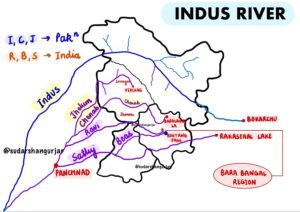
Fig. Indus River
Key Concepts
Indus Waters Treaty (1960)
- A bilateral water-sharing agreement between India and Pakistan, brokered by the World Bank.
- It governs the utilisation and management of the waters of the Indus River system.
Eastern Rivers
- Ravi, Beas and Sutlej.
- India enjoys unrestricted use of these rivers under the treaty.
Western Rivers
- Indus, Jhelum and Chenab.
- These rivers are primarily allocated to Pakistan, while India is permitted limited non-consumptive and specified uses under the treaty.
River Basin Management
- An integrated approach to planning, developing and managing water resources across an entire river basin to ensure ecological sustainability and efficient water utilisation.
Adaptive Water Governance
- A flexible water management framework that incorporates changing climatic conditions, scientific knowledge and hydrological variability into decision-making.
Way Forward
- Update the treaty’s technical provisions through mutual dialogue to address emerging issues such as climate change, hydrological variability, glacier retreat and modern data-sharing requirements.
- Strengthen institutional cooperation by improving dispute-resolution mechanisms and encouraging scientific collaboration between the two countries.
- Promote integrated river basin management supported by real-time monitoring and adaptive planning for sustainable water governance.
- Balance regional cooperation with national security, developmental needs and environmental sustainability to ensure long-term water security in the Indus basin.