


Tusker Uses Cleared Passage to Move to National Park
CONTEXT
- A wild tusker in Chinnakanal, Kerala, moved towards Mathikettan Shola National Park through a recently cleared natural elephant passage after illegal obstructions were removed.
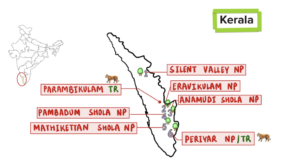
- The incident highlights the importance of maintaining ecological connectivity to facilitate safe wildlife movement.
KEY HIGHLIGHTS
- The elephant used the newly restored passage to reach a protected area, demonstrating how reviving traditional wildlife routes can facilitate animal movement.
- Human settlements, roads, agricultural expansion and other land use changes can block natural animal pathways and increase human wildlife interactions.
- Removing illegal fences and other artificial barriers can reconnect fragmented habitats and reduce the chances of animals entering human dominated areas.
- Elephant corridors are particularly important because elephants have extensive home ranges and regularly move between feeding, watering and breeding areas, often crossing administrative boundaries.
- Conservation efforts therefore need to move beyond isolated protected areas towards a landscape level approach that integrates protected areas, wildlife corridors, local communities and sustainable land use planning.
KEY CONCEPTS
- Wildlife Corridor: An ecological passage that connects fragmented habitats and enables animals to move between them for feeding, breeding and seasonal migration.
- Human Wildlife Conflict: Negative interactions between people and wildlife that may result in crop damage, livestock losses, injuries, human deaths or retaliatory killing of animals.
- Landscape Level Conservation: A conservation approach that focuses on entire ecological landscapes and their connectivity rather than treating protected areas as isolated units.
- Mathikettan Shola National Park: A protected area in Kerala’s Western Ghats, forming part of an ecologically important landscape supporting biodiversity and wildlife movement.
WAY FORWARD
- Wildlife corridors should be identified, legally secured and ecologically restored.
- Artificial barriers along important animal movement routes should be removed wherever possible.
- Local communities should be actively involved in conservation planning and human-wildlife conflict mitigation.