


Cauvery Water Dispute: Tamil Nadu – Karnataka Talks
Context
Tamil Nadu Chief Minister C. Joseph Vijay has initiated direct discussions with Karnataka Deputy Chief Minister D.K. Shivakumar over the long-pending Cauvery river water dispute. The move marks a shift from Tamil Nadu’s traditional reliance on judicial and tribunal-based resolution. Meanwhile, DMK president M.K. Stalin has expressed reservations, arguing that negotiations should not compromise Tamil Nadu’s legally protected water rights, particularly in the context of the proposed Mekedatu Reservoir Project.
Key Highlights
- Tamil Nadu has raised concerns over Karnataka’s release of Cauvery water, alleging that the State has not adhered to the quantities prescribed under the existing allocation framework.
- The decision to pursue direct political dialogue departs from Tamil Nadu’s long-standing strategy of resolving the dispute through statutory institutions and judicial mechanisms.
- Karnataka continues to support the Mekedatu balancing reservoir, whereas Tamil Nadu maintains that the project could adversely affect downstream irrigation and water availability.
- Critics argue that bilateral negotiations should complement, rather than bypass, the statutory role of the Cauvery Water Management Authority (CWMA) and the Cauvery Water Regulation Committee (CWRC).
- Farmer organisations in Tamil Nadu have sought wider stakeholder consultation, expressing concerns over any agreement that could dilute the State’s water entitlements.
Key Concepts
Cauvery Water Dispute
- A long-standing inter-state river water dispute involving Karnataka, Tamil Nadu, Kerala, and Puducherry over the sharing of Cauvery river waters.
- The dispute has been addressed through the Cauvery Water Disputes Tribunal (CWDT) and later modified by the Supreme Court.
Cauvery River
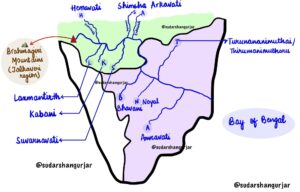
- Originates at Talakaveri in the Brahmagiri Hills (Kodagu district, Karnataka).
- Flows through Karnataka and Tamil Nadu, with Kerala and Puducherry as co-basin stakeholders, before draining into the Bay of Bengal.
- Major tributaries include Hemavati, Kabini, Bhavani, Amaravati, and Noyyal.
Cauvery Water Disputes Tribunal (CWDT)
- Constituted in 1990 under the Inter-State River Water Disputes Act, 1956.
- Delivered its final award in 2007, which was modified by the Supreme Court in 2018, revising water allocations between Karnataka and Tamil Nadu.
Cauvery Water Management Authority (CWMA)
- Established in 2018 to implement the Supreme Court-modified tribunal award.
- Oversees reservoir operations and water releases with assistance from the Cauvery Water Regulation Committee (CWRC).
Mekedatu Project
- A proposed balancing reservoir and drinking water project planned by Karnataka on the Cauvery near the Tamil Nadu border.
- Tamil Nadu opposes the project, arguing that it may reduce downstream water availability and impact irrigation in the Cauvery delta.
Constitutional & Legal Framework
- Article 262 empowers Parliament to legislate on inter-state river water disputes and permits exclusion of court jurisdiction in such matters.
- The Inter-State River Water Disputes Act, 1956 provides for the constitution of tribunals when negotiations between States fail.
tmc ft
- Thousand Million Cubic Feet (tmc ft) is the standard unit used for measuring reservoir storage and river-water allocation.
- 1 tmc ft ≈ 28.3 million cubic metres.
Way Forward
- Any political understanding should remain within the statutory framework of the CWMA to ensure legal enforceability.
- Develop a transparent distress-sharing mechanism for years of deficient rainfall to reduce recurring conflicts.
- Address the Mekedatu project independently from routine water-sharing arrangements to prevent issue linkage.
- Promote demand-side water management through crop diversification, micro-irrigation, improved canal efficiency, and scientific water-use planning across the basin.
- Strengthen cooperative federalism by combining institutional mechanisms with sustained inter-state dialogue and stakeholder participation.