


U.S.- Iran Conflict, Strait of Hormuz and the Challenge to Regional Deterrence
Context
- Following 13 consecutive nights of U.S. military strikes, Iran launched retaliatory attacks on American bases.
- U.S. President Donald Trump announced a temporary suspension of military operations, stating that further action would depend on the outcome of negotiations.
- Iran responded that it would maintain the pause only if the U.S. refrained from further attacks. It also asserted control over the Strait of Hormuz, claiming to have stopped multiple vessels attempting unauthorised passage.
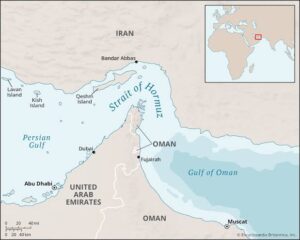
- Tehran indicated that it was not inclined to resume negotiations with Washington at this stage.
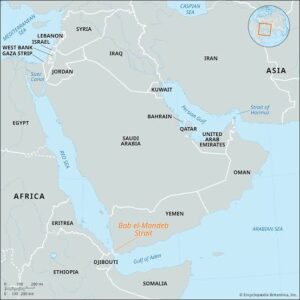
- Simultaneously, Iran-backed Houthi rebels targeted Saudi oil infrastructure, significantly reducing maritime traffic through the Bab-el-Mandeb Strait.
Key Highlights
- President Trump expressed optimism about the possibility of a diplomatic settlement but warned that military operations could restart if negotiations failed.
- Reports also highlighted concerns regarding the depletion of U.S. air-defence ammunition.
- Maritime traffic declined sharply:
- Fewer than 10 commodity vessels per day crossed the Strait of Hormuz during the weekend.
- Only 11 ships transited the Bab-el-Mandeb Strait on Sunday.
- Iran declared that shipping through the Strait of Hormuz would be subject to its conditions, reinforcing its strategic leverage.
- The conflict reflects a failure of deterrence and illustrates the security dilemma, where each side perceives its actions as defensive while the other views them as escalatory.
Key Concepts
Strait of Hormuz
- A narrow maritime passage connecting the Persian Gulf with the Gulf of Oman.
- At its narrowest point, it is about 21 nautical miles wide.
- Facilitates nearly 20% of global oil trade.
- Bordered by Iran, Oman and the UAE.
Bab-el-Mandeb Strait
- Connects the Red Sea with the Gulf of Aden and the Indian Ocean.
- Lies between the Horn of Africa and the Arabian Peninsula.
- Serves as a critical gateway to the Suez Canal.
Security Dilemma
- A situation in international relations where defensive actions by one country are interpreted as offensive by another, resulting in mutual suspicion and an escalation of tensions despite neither side seeking war.
Deterrence
- A strategy of preventing hostile actions by maintaining a credible threat of retaliation.
- It remains effective only when an adversary believes that declared red lines will be enforced.
Energy Security
- The ability of a country to ensure reliable, affordable and uninterrupted access to energy supplies, even during geopolitical crises or market disruptions.
Way Forward
- Diversify crude oil imports and strengthen Strategic Petroleum Reserves (SPR) to reduce vulnerability to supply disruptions.
- Enhance maritime security cooperation in the Indian Ocean Region to safeguard freedom of navigation and protect commercial shipping.
- Continue balanced diplomatic engagement with all stakeholders to promote stability in West Asia and safeguard India’s large diaspora and economic interests.
- Accelerate the energy transition by expanding renewable energy and reducing long-term dependence on imported crude oil.