


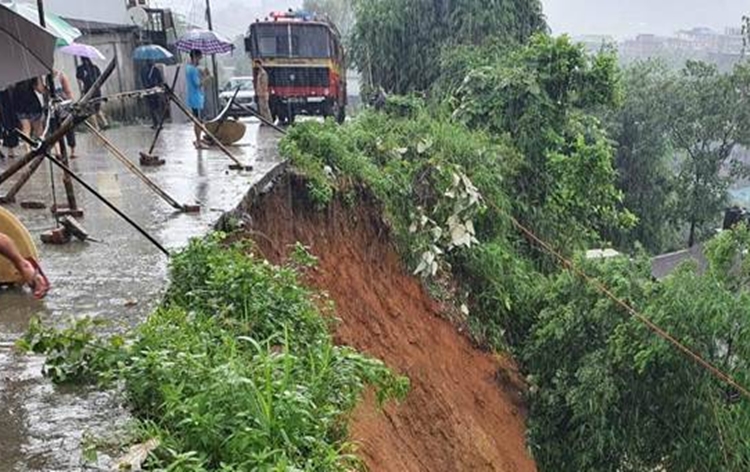
Heavy rains triggers landslides in Arunachal Pradesh
Context : Heavy rainfall in Arunachal Pradesh triggered flash floods and landslides, disrupting connectivity across several districts. The situation prompted Assam to issue a high alert in downstream districts due to the risk of flooding.
Prelims:
* Heavy rainfall caused flash floods and landslides in Arunachal Pradesh.
* The worst-affected area was Keyi Panyor district, particularly around the NEEPCO project site in Yazali Circle.
* Six districts experienced disruption due to monsoon-related damage:
* Keyi Panyor
* Kamle
* Kra Daadi
* Kurung Kumey
* Lower Subansiri
* Upper Subansiri
* A strategic bridge connecting East Kameng and Pakke Kessang districts was damaged.
* The Indian Air Force (IAF) conducted aerial sorties to assess damage and locate survivors.
* The Border Roads Organisation (BRO) and the Highway Department were engaged in restoring road connectivity.
* Assam issued a high alert for downstream districts due to the risk of flooding.
* The affected area includes a project of the North Eastern Electric Power Corporation Ltd. (NEEPCO).
* NEEPCO (North Eastern Electric Power Corporation Ltd.) is a Miniratna Category-I Central Public Sector Enterprise (CPSE) under the Ministry of Power, engaged in hydro, thermal, and renewable power generation, primarily in Northeast India.
Significance
* Highlights the increasing vulnerability of the Himalayan region to rainfall-induced disasters.
* Demonstrates how extreme weather events can simultaneously trigger landslides, flash floods, and infrastructure disruption.
* Shows the need for coordinated disaster response across inter-state river basins, as downstream areas are also affected.
Challenges
* Road and bridge damage leading to isolation of affected districts.
* Difficult rescue operations due to disrupted connectivity and adverse weather.
* Risk to critical infrastructure, including power projects.
* Secondary flood risk for downstream regions.
Way Forward
* Strengthen early warning systems for landslides and flash floods.
* Improve climate-resilient infrastructure, particularly roads and bridges in hilly regions.
* Enhance inter-agency coordination among the State Disaster Response Force (SDRF), NDRF, BRO, IAF, and state governments.
* Promote scientific land-use planning and slope stabilization in vulnerable Himalayan districts.