


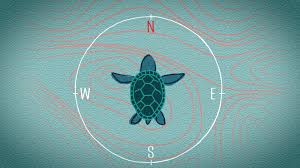
Sea Turtles Navigate Using Earth’s Magnetic Field
Context
A recent satellite-tracking study has shown that migrating sea turtles rely on Earth’s magnetic field as a natural navigation system. Instead of travelling in perfectly straight paths, they make continuous course corrections to stay on their migration routes despite shifting ocean currents.
Facts
- Sea turtles actively adjust their direction during long-distance migration rather than drifting with ocean currents.
- The study reinforces evidence that turtles possess magnetoreception, enabling them to sense Earth’s magnetic field for orientation.
- This magnetic compass helps turtles navigate across open oceans where visual landmarks are absent.
- Continuous course correction allows turtles to complete migrations spanning thousands of kilometres with remarkable accuracy.
- The findings improve scientific understanding of marine animal navigation and migration behaviour.
Concepts
Magnetoreception
- A biological capability that allows certain animals to detect Earth’s magnetic field for navigation and spatial orientation.
- Reported in sea turtles, migratory birds, salmon, sharks and several other marine organisms.
Satellite Telemetry
- A wildlife monitoring technique in which animals are fitted with satellite-linked transmitters to track their movement and behaviour in real time.
- Widely used for migration studies, conservation planning and ecological research.