


Water Governance in Peri-Urban Areas
What Happened
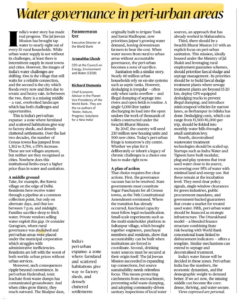
The article discusses the growing governance challenges in India’s peri-urban regions, where rapid urban expansion is creating serious water and sanitation pressures.
Key Highlights
- India’s peri-urban regions are expanding rapidly as villages transition into densely populated settlements and industrial corridors.
- The number of Census towns increased from 1,362 to 3,784 over the last two decades.
- Peri-urban areas often remain trapped in institutional limbo, being neither fully rural nor fully urban in governance structure.
- The article highlights water insecurity in peri-urban settlements despite proximity to urban centres.
- Rapid urban expansion is increasing pressure on nearby rural water resources.
- The Bisalpur dam, originally constructed for irrigation purposes, now prioritises Jaipur’s urban water demand.
- The article highlights irregular desludging and illegal dumping of septage into rivers and open fields.
- Nearly 40 million urban households rely on on-site sanitation systems such as septic tanks.
- The article estimates that India may require:
- 230 million new housing units
- 500 new cities by 2047
- The article recommends constituting Nagar Panchayats for Census towns as envisioned under the 74th Constitutional Amendment.
- The article emphasises the need to:
- Protect water catchments
- Prevent solid waste dumping
- Strengthen community-led water governance
- The article advocates decentralised wastewater treatment technologies and reuse of treated wastewater.
- It highlights examples such as modular wastewater systems developed by startups like Indra Water and Tigreen.
- The article recommends integrating peri-urban sanitation priorities into Swachh Bharat Mission 3.0.
Key Facts
- Jal Jeevan Mission has expanded tap-water access to a large share of rural households.
- Peri-urban India represents a transitional zone between rural and urban landscapes.
- Decentralised wastewater treatment can recover more than 95% of water near the source.
- The article cites blended-finance models, including the Uttarakhand model supported through World Bank-linked financing mechanisms.
Question? JJM 2.0 was launched on __________________.