


Furore over Mekedatu Project
Context : The Mekedatu Project has resurfaced as a major inter-state river water dispute after the Tamil Nadu Assembly passed a resolution opposing Karnataka’s proposal to construct a balancing reservoir across the Cauvery River at Mekedatu.
Prelims :
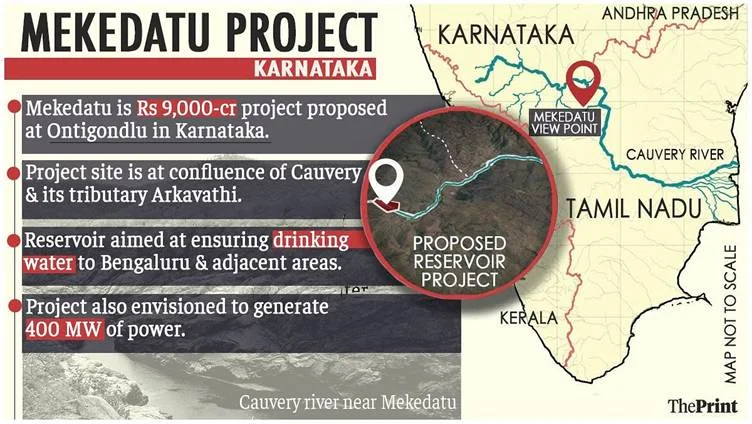
- Mekedatu is a proposed drinking water-cum-balancing reservoir on the Cauvery River in Karnataka, about 100 km from Bengaluru.
- The project proposes storage of 67.16 thousand million cubic feet (TMC ft) of water.
- It is estimated to cost around ₹9,000 crore.
- The project includes a 400 MW hydropower component, with no irrigation component.
- In its 2018 Cauvery water dispute judgment, the Supreme Court allocated an additional 4.75 TMC of Cauvery water to Karnataka for Bengaluru’s drinking water needs.
- Karnataka argues that the reservoir will regulate flood flows from Krishnaraja Sagar (KRS) and Kabini Reservoir to the Mettur Dam downstream in Tamil Nadu.
- Tamil Nadu contends that, due to the existing Cauvery water deficit, no new project should be undertaken.
- The Supreme Court recently termed Tamil Nadu’s challenge to Karnataka’s revised DPR as “premature.”
* The Cauvery River originates at Talakaveri (Karnataka) and flows through Karnataka and Tamil Nadu before draining into the Bay of Bengal.
Significance
* Highlights the complexities of inter-state river water sharing in India.
* Reflects the challenge of balancing urban drinking water needs, hydropower generation, and downstream water security.
* Demonstrates the role of judicial intervention in resolving interstate river disputes.
Key Issues
* Trust deficit between upper riparian (Karnataka) and lower riparian (Tamil Nadu) states.
* Concerns over the impact of upstream storage on downstream water availability.
* Lack of sustained bilateral negotiations despite the involvement of multiple stakeholders.
* Tension between developmental requirements and equitable river basin management.
Way Forward
* Strengthen cooperative federalism through regular inter-state consultations.
* Promote river basin-based integrated water resource management.
* Ensure scientific assessment of downstream impacts before project implementation.
* Encourage negotiated settlements alongside legal mechanisms for durable solutions.