


Houthi Red Sea Blockade Pushes Brent Crude Above $100
Context
- Yemen’s Houthi movement (Ansar Allah), backed by Iran, announced a blockade targeting Saudi-linked shipping in the Red Sea and attacked two Saudi-flagged oil tankers (Encelia and Layla).
- The escalation comes at a time when the Strait of Hormuz is already under pressure, extending the conflict to another critical maritime chokepoint.
- As a result, concerns over global oil supplies pushed Brent crude prices above $100 per barrel, registering a sharp rise of around 7%.
Key Highlights
- Saudi Arabia had redirected crude exports to its Yanbu terminal on the Red Sea through the East–West Pipeline after disruptions in the Strait of Hormuz. The Bab-el-Mandeb blockade now threatens this alternative export route as well.
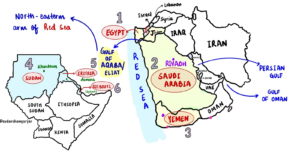
- Shipping companies may be forced to reroute vessels via the Cape of Good Hope, significantly increasing travel time from about 8 days to nearly 39 days on the Yanbu–India route, leading to higher freight and insurance costs.
- India imports around 5 million barrels of crude oil per day, but diversification of suppliers including Russia, the United States, Brazil, Guyana, and African nations helps reduce immediate supply risks.
- To strengthen energy security, India is developing Phase-II of the Strategic Petroleum Reserve (SPR) with an estimated investment of ₹14,527 crore under the PPP model, supported through Viability Gap Funding (VGF).
Key Concepts
Bab-el-Mandeb Strait
- A strategic maritime passage connecting the Red Sea with the Gulf of Aden and the Arabian Sea.
- Located between Yemen and Djibouti/Eritrea, it serves as the southern gateway to the Suez Canal.
Strait of Hormuz
- Connects the Persian Gulf with the Gulf of Oman.
- Handles nearly one-fifth of global oil trade, making it one of the world’s most critical energy chokepoints.
Strategic Petroleum Reserve (SPR)
- Emergency crude oil reserves maintained to safeguard against supply disruptions.
- India’s operational reserves are located at Visakhapatnam, Mangaluru, and Padur, and are managed by Indian Strategic Petroleum Reserves Limited (ISPRL).
Viability Gap Funding (VGF)
- Financial assistance provided by the Central Government to improve the commercial viability of infrastructure projects developed under the Public-Private Partnership (PPP) framework.
Way Forward
- Fast-track the implementation of SPR Phase-II while expanding crude import diversification.
- Enhance maritime security cooperation to ensure the safety of international shipping routes and Indian commercial vessels.
- Continue a balanced diplomatic approach with Iran, Gulf countries, and the United States to protect India’s strategic interests.
- Accelerate the transition towards cleaner energy sources to reduce long-term dependence on imported crude oil.