


Great Indian Bustard Rewilding Pilot
CONTEXT
- Two captive bred male Great Indian Bustard (GIB) chicks have been prepared for a pilot release within enclosures at Desert National Park in Jaisalmer, Rajasthan.
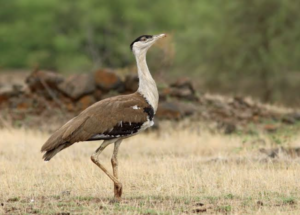
- The initiative marks the beginning of the rewilding phase of Project GIB, following the establishment of an insurance population through captive breeding.
- The timing of the release has been planned around the end of the monsoon, when increased insect availability in the grasslands can support the feeding requirements of the chicks.
- The Great Indian Bustard has a slow reproductive cycle and generally lays one egg every one to two years.
KEY HIGHLIGHTS
- The critically endangered wild population of the Great Indian Bustard is estimated at around 140 birds, with the largest population found in Rajasthan.
- The released birds will be radio tagged and initially kept in protected enclosures as part of a soft release strategy.
- The species has a very low reproductive rate, usually producing one egg in one to two years.
- Major threats include habitat degradation, predation and collisions with overhead power transmission lines.
- At least 98 birds have been bred at conservation centres located in Sam and Ramdevra.
KEY CONCEPTS
- Rewilding: The process of restoring captive bred or rescued animals to suitable habitats with the aim of rebuilding viable wild populations.
- Soft release: A conservation approach in which animals are gradually acclimatised to their surroundings in protected conditions before being allowed unrestricted movement.
- The Great Indian Bustard is a flagship species of India’s arid and semi arid grassland ecosystems.
WAY FORWARD
- The reintroduction programme should follow an adaptive and science based approach, supported by long term monitoring of survival and behaviour.
- Greater attention is required towards predator management, genetic planning and reducing the risk of collisions with transmission lines.