


Cauvery Water Dispute: Karnataka Releases Limited Water Amid Distress
Context
Following an improvement in rainfall, Karnataka Chief Minister D.K. Shivakumar announced the release of a limited quantity of Cauvery water to Tamil Nadu, primarily to meet drinking water requirements. The move complies with the Cauvery Water Management Authority (CWMA) directive requiring Karnataka to release 3,500 cusecs of water daily for 15 days. Despite this, pro Kannada organisations have announced a bandh on August 13, while the DMK has approached the Supreme Court seeking enforcement of the CWMA order.
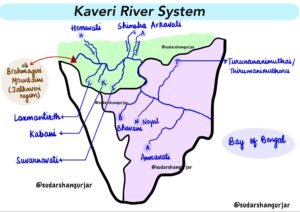
Key Highlights
- Karnataka has begun releasing water from the Kabini and Krishnaraja Sagar (KRS) reservoirs, with the flow expected to reach Tamil Nadu’s Mettur Dam shortly.
- Following recent rains, the four major reservoirs in the Cauvery basin in Karnataka are collectively receiving nearly 68,000 cusecs of inflow.
- Water availability at Biligundlu, the interstate measuring point, remained significantly below expectations, recording only about 1 tmc ft against the stipulated 31 tmc ft for July.
- The situation has revived discussions on establishing a distress-sharing formula to equitably distribute water during deficient monsoon years, an issue that has remained unresolved for decades.
- Karnataka has once again advocated the Mekedatu Balancing Reservoir Project as a long-term solution for drinking water security and river management.
Key Concepts
Cauvery Water Management Authority (CWMA) & Cauvery Water Regulation Committee (CWRC)
- The CWMA is the statutory authority responsible for implementing the Cauvery water-sharing award.
- The CWRC functions as the technical body assisting the CWMA in monitoring reservoir levels and regulating water releases.
- Both institutions were established following the 2018 Supreme Court judgment, which modified the Cauvery Water Disputes Tribunal award.
Constitutional & Legal Framework
- Article 262 of the Constitution empowers Parliament to provide for adjudication of inter-state river disputes.
- The Inter State River Water Disputes Act, 1956 enables the establishment of tribunals for resolving such disputes and limits the jurisdiction of courts once a dispute is referred to a tribunal.
- Tribunal awards, as modified or upheld by the Supreme Court, are binding on the concerned states.
Distress-Sharing Formula
- It refers to a predetermined mechanism for proportionately sharing water shortages among riparian states during years of inadequate rainfall, ensuring equitable distribution instead of ad hoc decisions.
Mekedatu Project
- The proposed Mekedatu Balancing Reservoir on the Cauvery River aims to enhance drinking water supply and generate hydropower in Karnataka.
- Tamil Nadu has consistently opposed the project, arguing that it could adversely affect downstream water availability.
Way Forward
- Develop a transparent and legally enforceable distress sharing framework for drought years to minimise recurring disputes.
- Strengthen the implementation and enforcement powers of the CWMA to ensure timely compliance with water-sharing orders.
- Encourage efficient water management practices, including micro-irrigation, improved reservoir operations, and demand-side water conservation across basin states.
- Promote cooperative federalism through regular coordination and scientific decision-making to reduce political conflicts over river water sharing.