


Cuba: Geographical Features and Strategic Significance
Context
Cuba’s national electrical grid experienced a complete collapse on Friday, resulting in a nationwide power outage that affected more than 9 million people.
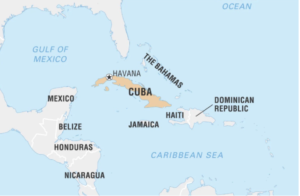
About Cuba
Location and Political Status
- Cuba is a sovereign archipelagic country located in the West Indies.
- It is the largest and most populous island in the Caribbean.
- Politically, Cuba functions as a unitary socialist republic.
Capital
Havana (La Habana) is the capital of Cuba. Located on the island’s northwestern coast, it serves as the country’s major commercial, political and cultural centre.
Maritime Boundaries
Cuba is surrounded by important water bodies and maritime passages, including:
- Straits of Florida
- Windward Passage
- Caribbean Sea
- Gulf of Mexico
Key Geographical Features
Mountain Ranges and Highest Peak
Mountainous terrain accounts for approximately one fourth of Cuba’s area. The Sierra Maestra range lies in the southeastern part of the country and contains Pico Turquino (1,974 m), the highest peak in Cuba.
Karst Landscape and Mogotes
Western Cuba, particularly the Viñales Valley, is notable for its distinctive limestone formations known as mogotes. The region also has extensive underground cave systems.
Agricultural Plains
Plains occupy nearly two thirds of Cuba. Its fertile lowlands have traditionally supported the cultivation of sugarcane, tobacco and citrus crops.
Zapata Wetlands
The Zapata Peninsula contains the largest wetland ecosystem in the Caribbean. Its landscape includes swamps, mangroves and coastal marshes, including the Bay of Pigs.
Rivers and Lagoons
Cuba has nearly 600 rivers, most of which are relatively short. The Cauto River, measuring about 370 km, is the longest river in the country.
The Laguna de Leche is notable for its distinctive milky white water.
Significance
Strategic Location
Cuba occupies a strategically important position between the Gulf of Mexico, Caribbean Sea and Atlantic Ocean. Its location places it close to important maritime routes and the Panama Canal.