


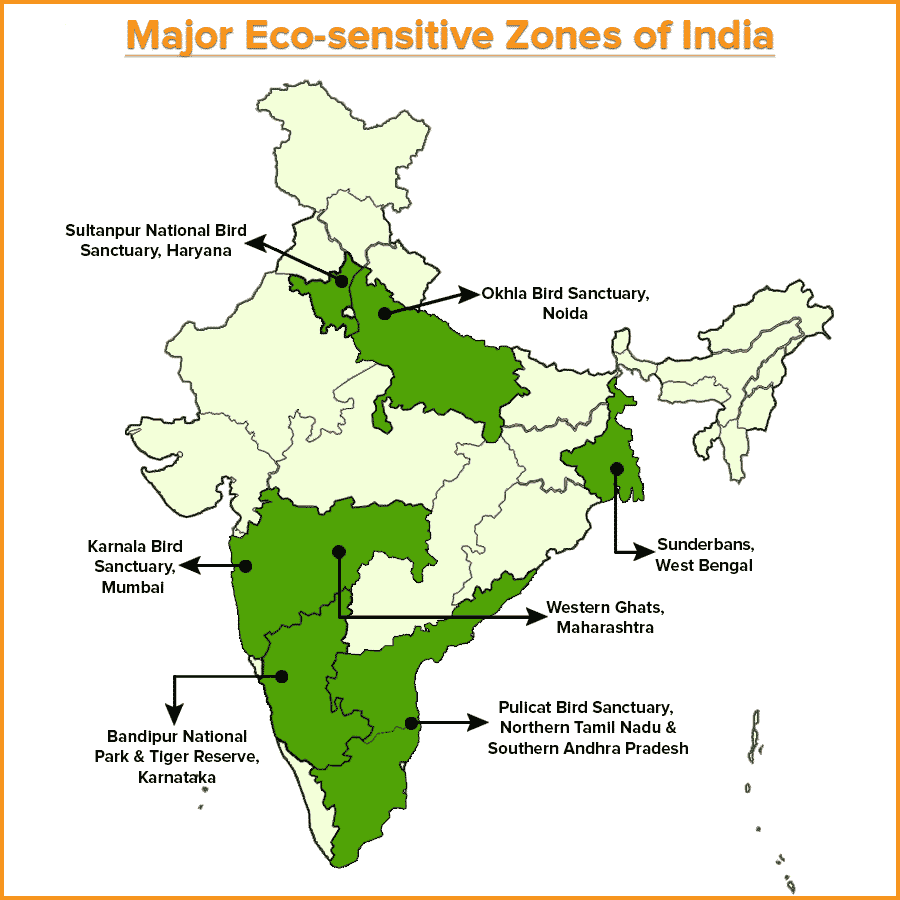
Eco-Sensitive Areas
Context: The Karnataka government has requested the Union Ministry of Environment, Forest and Climate Change (MoEF&CC) to withdraw the sixth draft notification proposing the declaration of Eco-Sensitive Areas (ESAs) in the Western Ghats.
- Eco-Sensitive Areas are ecologically important regions surrounding protected areas such as national parks and wildlife sanctuaries. They are designated as buffer zones to minimize the adverse impact of human activities on sensitive ecosystems and biodiversity.
Legal and Policy Basis
- Declared under the Environment (Protection) Act, 1986.
- Guided by the National Wildlife Action Plan (2002–2016) prepared by the MoEF&CC.
Origin of the ESA Concept
- ESAs were conceived to provide an additional protective layer around protected areas.
- The Western Ghats Ecology Expert Panel and the Kasturirangan Committee recommended the identification of ESAs, particularly in ecologically fragile landscapes such as the Western Ghats.
Activities in ESAs
Prohibited Activities
- Commercial mining
- Polluting industries
- Large hydroelectric projects
- Sawmills and commercial use of forest wood
Regulated Activities
- Tree felling
- Construction of hotels and resorts
- Commercial extraction of water
- Laying electrical transmission infrastructure
- Changes in agricultural land use
Permitted Activities
- Organic farming
- Rainwater harvesting
- Use of renewable energy
- Continuation of traditional agricultural practices
Significance of ESAs
- Biodiversity Conservation: Regulating human activities helps prevent habitat degradation and protects wildlife.
- Reducing Human-Wildlife Conflict: Maintaining ecological corridors helps minimize encounters between wildlife and human settlements.
- Buffer Function: ESAs act as shock absorbers for protected areas, balancing developmental pressures with conservation needs.
- Climate Resilience: Preserving natural landscapes enhances ecosystem resilience to climate change.
- In-situ Conservation: Threatened species can be conserved within their natural habitats, as seen in areas such as Kaziranga National Park.
Major Challenges
- Development–Conservation Trade-off: Reconciling economic growth with ecological protection remains difficult.
- Livelihood Concerns: Restrictions may affect communities dependent on forest and natural resources.
- Policy Variations: Differences in implementation across states create uncertainty and enforcement gaps.
- Encroachment and Illegal Activities: Mining, deforestation, and unauthorized land use continue to threaten ecological integrity.
- Limited Local Participation: Inadequate involvement of local communities often reduces compliance and effectiveness.
Way Forward
- Enhance Community Participation: Empower Gram Sabhas and local institutions in ESA governance.
- Promote Sustainable Development: Encourage organic farming, eco-tourism, and other environmentally friendly livelihoods.
- Ensure Policy Clarity: Develop transparent and consistent guidelines for ESA implementation.
- Strengthen Scientific Assessment: Conduct rigorous environmental impact assessments before approving projects.
- Support Alternative Livelihoods: Provide financial assistance, skill development, and market access for affected communities.
Conclusion
Eco-Sensitive Areas are an important instrument for achieving a balance between environmental conservation and sustainable development. Their long-term success depends on a participatory approach that safeguards fragile ecosystems while also addressing the developmental and livelihood aspirations of local communities.