


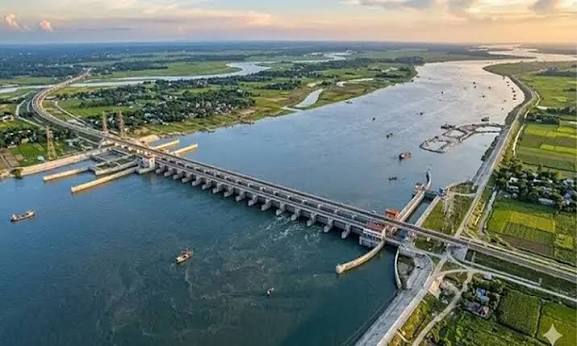
The Padma Barrage
Context: Bangladesh has formally approved the construction of the Tk 50,443 crore (approximately ₹39,170 crore) Padma Barrage project to address seasonal water shortages and strengthen its management of downstream water resources.
About the Padma Barrage
The Padma Barrage is a large-scale transboundary water management project planned by Bangladesh. Conceived as a major reservoir-based infrastructure, it aims to regulate river flows, enhance groundwater recharge, and improve water availability in downstream regions, particularly in response to upstream interventions such as India’s Farakka Barrage.
Location:
- The barrage is being constructed across the main channel of the Padma River.
- It is located about 180 km downstream of the Farakka Barrage in West Bengal, placing it relatively close to the India-Bangladesh border.
Key Features
Physical Dimensions: The proposed structure will consist of a concrete-supported barrage extending approximately 2.1 km in length.
Reservoir Capacity: The project has been designed with a storage capacity of nearly 2,900 million cubic metres of freshwater.
Population Coverage: It is expected to improve irrigation facilities and drinking water availability for around 6.5 crore people residing in the southwestern and northern parts of Bangladesh.
Project Cost and Timeline: The estimated cost of the project is Tk 50,443 crore (around ₹39,170 crore), with construction expected to be completed over a period of seven years.
- The Padma River is one of Bangladesh’s major transboundary rivers and represents the principal distributary channel of the Ganga after it enters Bangladesh from India.
- The Ganga originates at Devprayag in Uttarakhand through the confluence of the Alaknanda and Bhagirathi rivers.
- After crossing into Bangladesh near Shibganj, the Ganga assumes the name Padma.
- The Padma meets the Jamuna River at Goalundo and later joins the Meghna River near Chandpur before ultimately draining into the Bay of Bengal.