


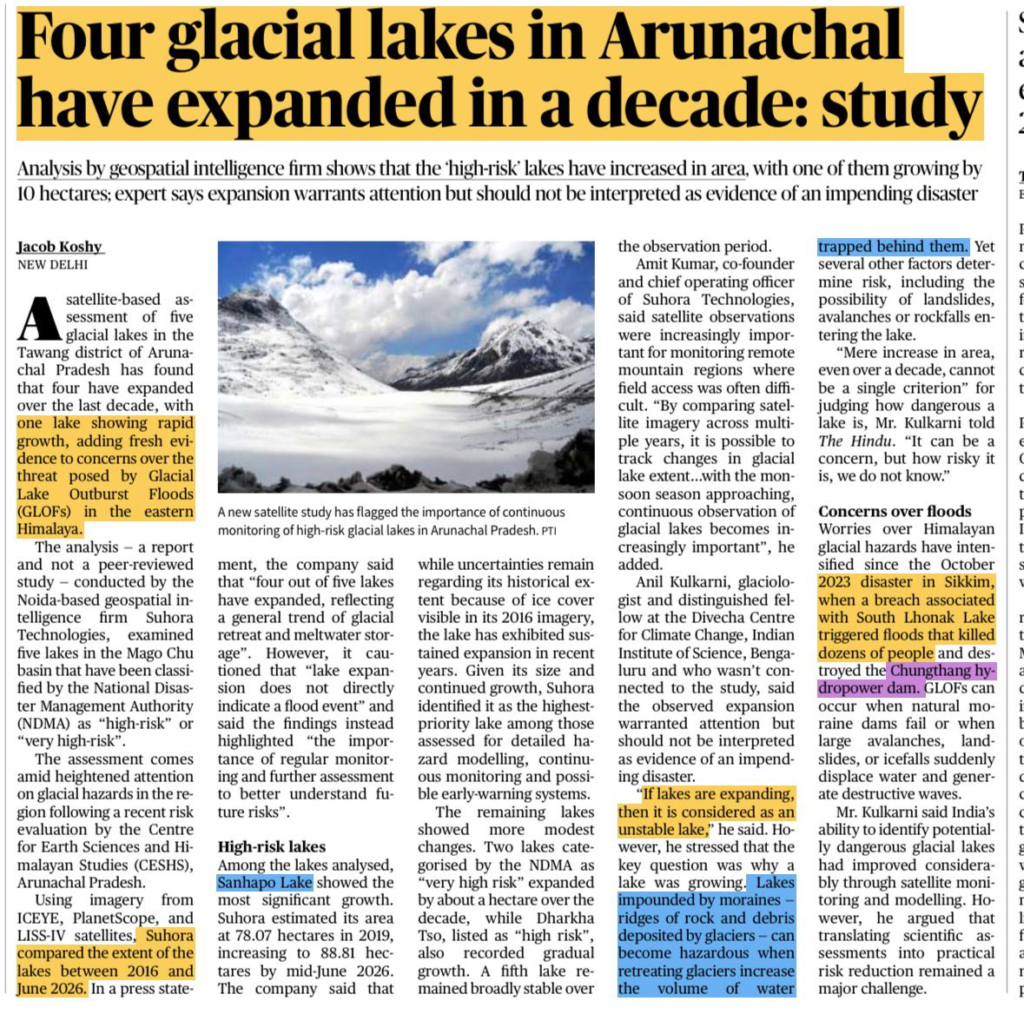
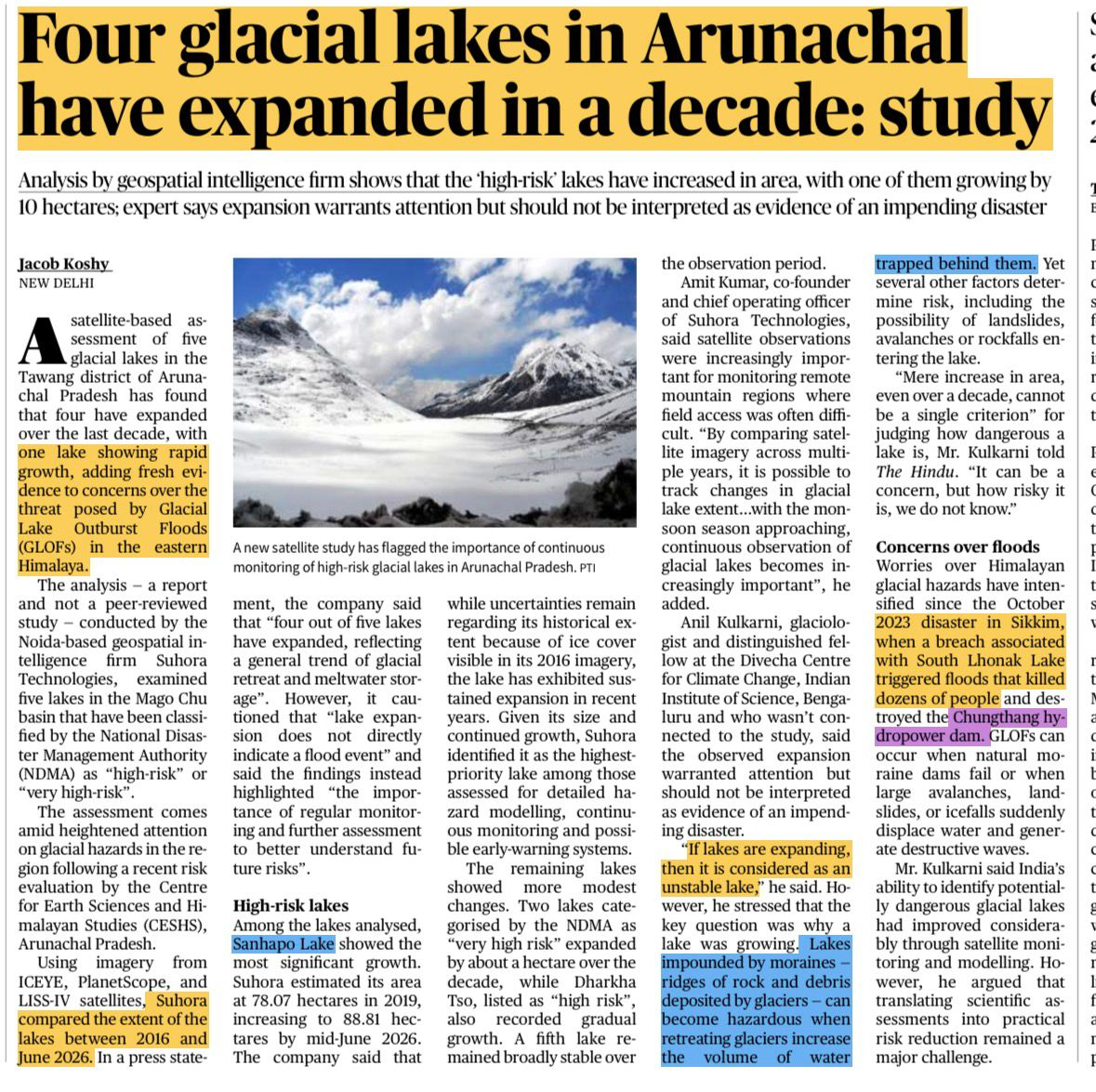
Four Glacial Lakes in Arunachal have expanded in a decade
Context: A satellite-based assessment of glacial lakes in Arunachal Pradesh’s Tawang district found that four out of five high-risk lakes have expanded between 2016 and 2026, raising concerns over Glacial Lake Outburst Floods (GLOFs) in the Eastern Himalayas.
Prelims :
- The study was conducted by Suhora Technologies, a geospatial intelligence firm.
- Assessment covered five glacial lakes in the Mago Chu Basin of Tawang district, Arunachal Pradesh.
- The lakes were previously classified as “High-Risk” or “Very High-Risk” by the National Disaster Management Authority (NDMA).
- Satellite imagery from ICEYE, PlanetScope, and LISS-IV was used for analysis.
- Comparison of lake extents was carried out between 2016 and June 2026.
- Four out of five lakes showed expansion, indicating continued glacier retreat and increased meltwater accumulation.
Key Findings
- Sanhapo Lake recorded the most significant growth.
- The area increased from 78.07 hectares (2019) to 88.81 hectares (2026).
- Expansion of nearly 10 hectares.
- Two other lakes categorized as “Very High Risk” expanded by around one hectare each.
- Another high-risk lake also showed gradual expansion.
- One lake remained largely stable during the observation period.
About Glacial Lake Outburst Floods (GLOFs)
- GLOFs occur when water stored in glacial lakes is suddenly released.
- They are often triggered by:
- Failure of natural moraine dams.
- Avalanches or landslides entering the lake.
- Ice or rockfalls causing displacement waves.
- GLOFs can generate devastating downstream floods.
Important Concepts
- Moraine: Accumulation of rock debris and sediments deposited by glaciers.
- Moraine-Dammed Lakes: Lakes impounded behind glacial debris deposits.
- Retreating glaciers can increase water accumulation in such lakes, potentially elevating risk levels.
Key Observations by Experts
- Expansion of a glacial lake does not automatically indicate an imminent disaster.
- Lake size alone is not sufficient to determine risk.
- Other factors such as:
- Slope stability,
- Landslides,
- Avalanches,
- Rockfalls,
- Nature of the moraine dam
Why It Matters?
- Concerns over Himalayan glacial hazards have intensified after the South Lhonak Lake GLOF in Sikkim (October 2023).
- The flood caused severe damage downstream, including destruction of the Chungthang Hydropower Project and significant loss of life.
- Continuous satellite monitoring is increasingly important because many Himalayan glacial lakes are located in remote and inaccessible terrain.
Mains :
- Illustrates the impact of climate change and glacier retreat in the Himalayas.
- Highlights the need for:
- Continuous satellite-based monitoring,
- Early warning systems,
- Hazard modelling,
- Disaster preparedness in mountain regions.
- Demonstrates the growing importance of remote sensing and geospatial technologies in disaster risk reduction.