


Scientists Puzzled as Whale Calves Wash Up Dead in Argentina
Context
An unusually high number of southern right whale calves have been found dead along Argentina’s Patagonian coast. Scientists are investigating whether marine bacterial infections, environmental changes or other ecological factors could be responsible for the unusual mortality.
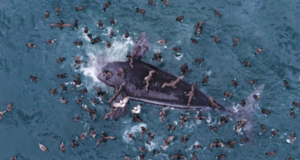
Key Highlights
- An unusually large number of dead whale calves have been reported around Península Valdés, an important breeding and nursing area for southern right whales.
- One of the major hypotheses is that some calves may have developed marine bacterial infections, potentially following injuries caused by attacks from seabirds.
- Researchers are collecting tissue and organ samples from the carcasses to identify possible pathogens and establish whether infections contributed to the deaths.
- Scientists are also examining wider environmental factors, including rising sea temperatures and El Niño-related changes, which can influence marine ecosystems, food availability and the distribution of pathogens.
- Although southern right whale populations have recovered considerably following restrictions on commercial whaling, the species continues to face threats such as food scarcity, fishing gear entanglement, ship strikes and changes in marine ecosystems.
Key Concepts
- Southern Right Whale: A large baleen whale that migrates between feeding and breeding grounds. Its population has shown significant recovery following protection from commercial whaling.
- Marine Disease Ecology: The study of interactions between pathogens, environmental conditions and marine animal populations within ocean ecosystems.
- El Niño: A periodic warming of the central and eastern tropical Pacific Ocean that affects atmospheric circulation and can influence rainfall, temperatures and marine ecosystems across different regions.
- Bioindicator Species: A species whose health, abundance or population changes can provide insights into the condition of an ecosystem.
- Marine Conservation: Protection and sustainable management of oceans, coastal ecosystems and marine species against human-induced and environmental pressures.
Way Forward
There is a need to strengthen marine disease surveillance, carcass monitoring and ecosystem based research to better understand unusual mortality events. At the same time, anthropogenic pressures such as fishing gear entanglement, ship strikes and habitat degradation should be reduced to improve the conservation of marine species.